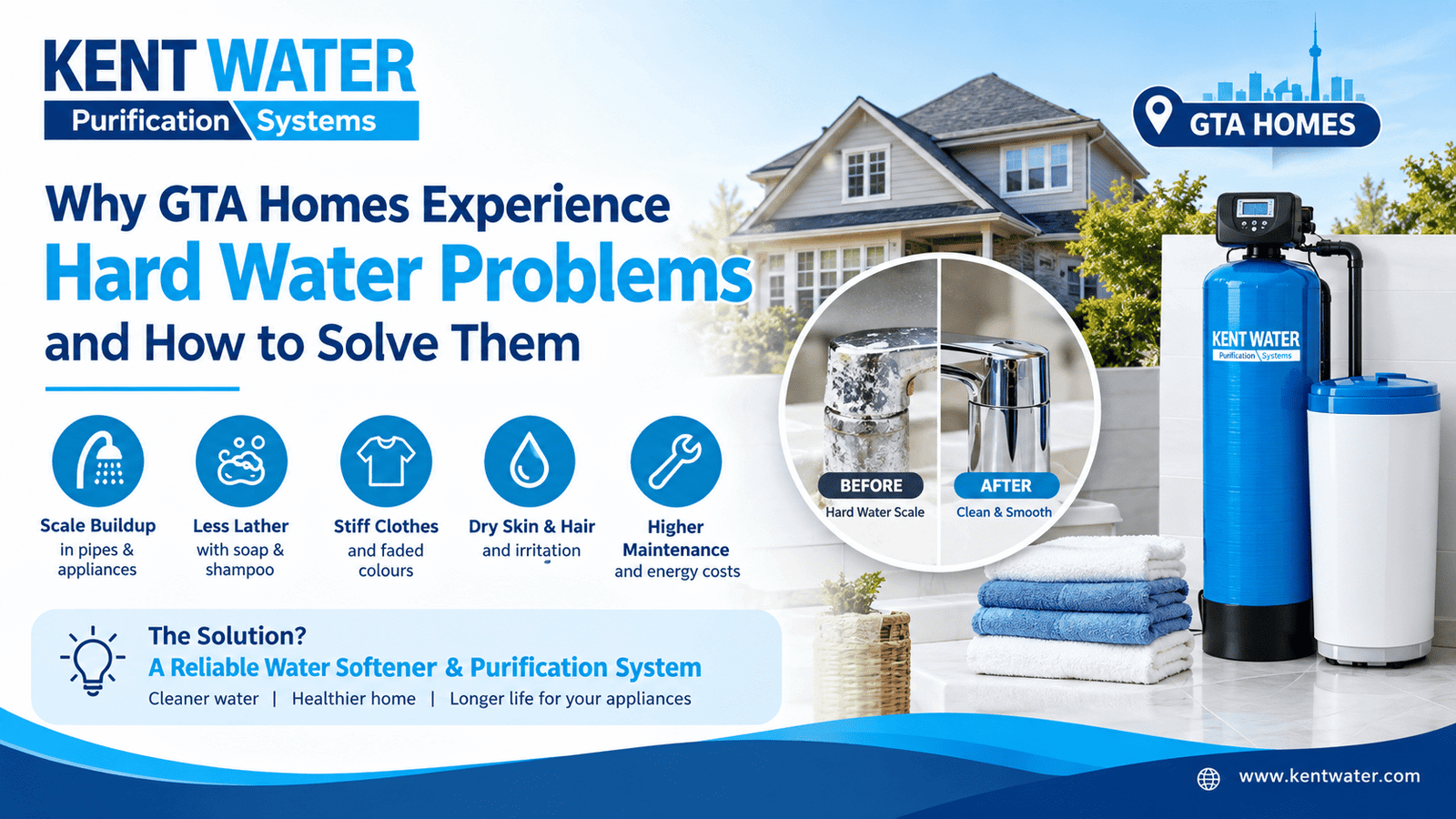
If you live in the Greater Toronto Area (GTA), you may have noticed white spots on your faucets, mineral buildup around your shower, dry-feeling skin after bathing, or scale collecting inside appliances. These are some of the common signs associated with hard water.
Hard water is not unusual in the GTA. Water hardness varies across the region because different communities receive water from different sources, including Lake Ontario and groundwater. Groundwater generally picks up more naturally occurring calcium and magnesium as it moves through rock and soil.
The important question for homeowners is not simply whether the water is hard. It is how hard the water is, how it affects your home, and whether treatment is actually necessary.
What Is Hard Water?
Hard water contains dissolved minerals, mainly calcium and magnesium.
These minerals occur naturally in water. When water passes through mineral-rich soil and rock, it can dissolve some of those minerals and carry them into groundwater.
Water hardness is normally measured as milligrams per litre of calcium carbonate (mg/L as CaCO₃) or in grains per gallon.
The higher the mineral concentration, the more likely you are to notice scale and other household effects.
For example, Peel Region’s 2025 South Peel water-quality report recorded hardness of approximately 120–130 mg/L as calcium carbonate at its two major treatment plants. The report describes hardness as naturally occurring and related to mineral content.
Hardness is not the same thing as contamination. It is primarily a mineral characteristic of water.
Why Is Hard Water Common in the GTA?
One reason is the geology of Southern Ontario.
The GTA contains areas where groundwater passes through mineral-rich geological formations. As groundwater travels underground, it can dissolve calcium and magnesium before reaching wells and entering a water supply.
This is particularly important in communities that rely partly or heavily on groundwater.
Durham Region, for example, explains that groundwater tends to contain higher concentrations of calcium and magnesium than surface water and publishes different hardness levels for its various drinking-water systems.
The situation is different in Toronto.
Toronto’s municipal drinking water comes from Lake Ontario, and the City describes its water as having relatively low levels of calcium and magnesium, meaning water softening systems are generally not needed for most Toronto homeowners.
This is an important point for GTA homeowners: you cannot assume that every neighbourhood has the same water hardness simply because it is located within the GTA.
What Problems Can Hard Water Cause at Home?
Hard water is usually more of a household-maintenance concern than a drinking-water safety concern.
Here are some of the problems homeowners commonly notice.
1. White Deposits on Faucets
If you regularly see a chalky white layer around your kitchen or bathroom taps, dissolved minerals may be responsible.
As water evaporates, calcium and other minerals can remain behind and form visible deposits.
These deposits can become harder to remove when they are allowed to build up over time.
2. Scale on Showerheads
Mineral deposits can collect around the small openings in showerheads.
Over time, this buildup can affect water flow and make fixtures look dirty even after regular cleaning.
A descaling solution can remove existing deposits, but if hard water continues to enter the fixture, the deposits can return.
3. Spots on Glassware and Dishes
Hard water can leave mineral spots on glasses, plates and cutlery.
You may notice a cloudy or spotted appearance after washing dishes, particularly when water droplets are allowed to dry naturally.
The dishwasher detergent, rinse aid, water temperature and hardness level can all influence how noticeable the spots become.
4. Soap Scum
Calcium and magnesium can react with soap and contribute to deposits commonly called soap scum.
This can make bathroom cleaning more time-consuming.
You may notice buildup around:
- Bathtubs
- Shower doors
- Sinks
- Tiles
- Faucets
5. Water Heater and Appliance Scale
Scale can accumulate in equipment that regularly heats water.
This is one reason homeowners with harder water may pay more attention to their water heater, dishwasher, washing machine and other water-using appliances.
The effect depends on the hardness level, equipment design, water temperature and how frequently the appliance is used.
Is Hard Water Bad for Your Health?
This is where homeowners should separate water hardness from other water-quality concerns.
Hardness is primarily caused by naturally occurring calcium and magnesium. It does not automatically mean that the water is unsafe to drink.
Municipal drinking water in the GTA is treated and monitored under Ontario’s drinking-water requirements. Toronto, for example, states that its tap water is safe to drink and is continuously tested to ensure it meets or exceeds provincial requirements.
So, if your concern is white scale on a faucet, installing a filtration system should not be treated as a response to an unsafe-water situation.
Instead, the appropriate treatment depends on the specific problem.
Water Filter vs. Water Softener: What Is the Difference?
This is one of the most important things to understand before purchasing a water-treatment system.
Water Filter
A filter is designed to reduce specific substances from water depending on the filtration technology used.
Different filters may target:
- Sediment
- Chlorine-related taste and odour
- Certain chemicals
- Specific contaminants
Water Softener
A conventional water softener is designed primarily to reduce calcium and magnesium, the minerals responsible for water hardness.
So if your main problem is scale, a softener may be more relevant than a standard drinking-water filter.
Installing a basic carbon filter will not necessarily solve a hard-water problem.
How Does a Water Softener Work?
Traditional water softeners generally use an ion-exchange process.
Inside the softener is a resin that attracts calcium and magnesium ions. The system exchanges these hardness minerals for sodium ions.
The resin eventually becomes loaded with hardness minerals and needs to be regenerated.
During regeneration, the system uses a salt solution to restore the resin’s ability to exchange minerals.
Because of this process, homeowners should understand that water softeners can increase sodium levels in treated water. Peel Region specifically notes that softeners replace naturally occurring calcium and magnesium with sodium.
For households where sodium intake is an important consideration, it is worth discussing the drinking-water setup with a qualified professional before choosing a softener.
Do You Need a Water Softener in Your GTA Home?
Not necessarily.
The answer depends on your local water hardness and whether it is causing problems that you want to address.
A softener may be worth considering if you regularly experience:
- Heavy scale buildup
- Difficult-to-clean mineral deposits
- Persistent showerhead scaling
- Significant spotting on dishes
- Hard-water problems affecting household equipment
On the other hand, if your local water has relatively low hardness and you are not experiencing meaningful household problems, a softener may provide little practical benefit.
Toronto’s municipal water is one example where the City says water softening systems are usually unnecessary for most homeowners because of relatively low hardness.
How to Find Out How Hard Your Water Is
Before purchasing a water softener, find out your actual water hardness.
Start by checking your municipality’s published water-quality information.
GTA municipalities publish water-quality reports for their drinking-water systems. Halton Region, for example, publishes annual reports covering the source, composition and compliance of its drinking water.
You can also have water tested if you want information specific to your home.
This can be especially useful when:
- You use a private well
- Your home has older plumbing
- You notice unusual changes in water quality
- You are unsure whether the problem is hardness or something else
A water test can help prevent you from buying equipment based solely on a sales pitch.
What About Well Water in the GTA?
Hard-water problems can be more noticeable in homes that rely on private wells.
Groundwater naturally interacts with the surrounding soil and rock. Depending on the location, it can contain different levels of minerals.
If you live in a rural or semi-rural part of the GTA and use a private well, don’t assume that a standard softener is the only treatment you need.
Well water should be tested according to the circumstances of the property.
The treatment should then be selected based on the results.
Other Signs That May Not Be Caused by Hard Water
Not every water problem is a hardness problem.
For example, rusty or discoloured water can have different causes.
If only one tap in your home is affected, the issue may be related to your home’s plumbing. Toronto notes that when only one tap is affected, the problem is likely within the home’s plumbing, while broader discolouration can have other causes such as nearby watermain work or construction.
This is why replacing a filter or installing a softener without identifying the cause may not solve the underlying problem.
How to Solve Hard Water Problems
There are several ways to deal with hard water depending on how severe the issue is.
Option 1: Regular Descaling
For mild problems, regular cleaning may be enough.
Vinegar or an appropriate commercial descaling product can help remove mineral deposits from fixtures.
Toronto also recommends vinegar or a commercial hardness remover for mineral deposits on fixtures.
This approach does not change the water itself, but it can help manage visible buildup.
Option 2: Water Softener
If hard water is causing persistent problems throughout the home, a properly sized water softener may be a practical option.
A professional should consider:
- Water hardness
- Household size
- Daily water usage
- Number of bathrooms
- Plumbing configuration
- Regeneration requirements
Avoid selecting a system simply because it has the largest capacity or highest price.
Option 3: Point-of-Use Filtration
If your concern is primarily drinking-water taste or odour rather than hardness, an under-sink filtration system may make more sense.
This treats water at the location where you drink or cook rather than treating the entire house.
Option 4: Reverse Osmosis
Reverse osmosis can provide more extensive treatment for drinking and cooking water.
However, RO is not a replacement for a water softener when the main issue is whole-house hardness.
These systems serve different purposes.
How Much Does Hard Water Treatment Cost?
The cost can vary considerably.
Factors include:
- Type of treatment
- System capacity
- Brand and equipment quality
- Installation requirements
- Plumbing modifications
- Filter or salt requirements
- Maintenance
- Warranty
A basic drinking-water filter and a whole-home softening system are very different purchases.
When comparing quotes, look beyond the installation price.
Ask about the ongoing cost of:
- Salt
- Replacement filters
- Membranes
- Servicing
- Repairs
- Electricity
- Other consumables
A cheaper system may not necessarily have the lowest long-term cost.
How to Choose a GTA Water Treatment Company
If you decide to hire a water-treatment company, ask questions before signing a contract.
Ask for a water assessment
The company should understand your water source and the actual problem.
Ask what the system removes
Don’t accept a general statement such as “this system cleans your water.”
Ask exactly what the equipment is designed to reduce.
Ask about certification
If the company makes specific contaminant-reduction claims, ask for the relevant third-party certification and performance information.
Ask about maintenance
Find out how often the system needs servicing and what replacement parts cost.
Ask about warranty
Understand what is covered and for how long.
Get the complete price
Make sure you know whether installation, plumbing work, taxes and future servicing are included.
Be Careful With Door-to-Door Water Treatment Sales
Homeowners should be particularly careful when someone arrives at the door offering a free water test or claiming to represent a local water authority.
Durham Region specifically warns residents about door-to-door water-treatment salespeople who claim to be partners with the Region and recommends confirming such claims with the Region.
A legitimate water-quality concern should not require you to make an immediate purchase.
Take time to verify the information, check municipal sources and compare treatment options.
GTA Hard Water: What Homeowners Should Remember
Hard water is a natural characteristic of water caused mainly by dissolved calcium and magnesium.
Its impact can vary significantly across the GTA because communities use different water sources and treatment systems.
Some areas have relatively low hardness, while groundwater-dependent systems can have substantially higher mineral levels. Durham Region’s published data, for example, shows considerable variation in hardness between its different drinking-water systems.
That means there is no single water-treatment solution that is right for every GTA home.
The sensible approach is straightforward:
Check your local water information → identify the actual problem → test when appropriate → choose treatment based on the results.
If your main issue is scale and mineral deposits, look into water softening. If your concern is drinking-water taste or a specific contaminant, investigate an appropriate filtration system instead.
The goal is not simply to make water “softer” or “more filtered.” The goal is to choose treatment that addresses the problem your household actually has.
Final Thoughts
Hard water can be frustrating, especially when mineral deposits keep appearing on fixtures, appliances and shower surfaces.
But the solution does not always require an expensive whole-house system.
Start by checking the water-quality information for your municipality. Understand your home’s water source and determine whether the issue is actually hardness. If necessary, have the water tested and discuss the results with a qualified water-treatment professional.
For many homeowners, simple maintenance may be enough. For others, a properly selected water softener can make everyday cleaning and appliance maintenance easier.
The important thing is to match the treatment to the water problem instead of buying a system based on a general claim that GTA water is hard.