Most people notice hard water on their showerhead or their kettle long before they notice it inside their water heater. That’s the problem. The visible buildup is a small fraction of what’s actually happening throughout your plumbing and appliances, where scale accumulates quietly for years before anything fails.
A 2009 study by the Battelle Memorial Institute, commissioned through the Water Quality Research Foundation, tested residential water heaters under hard water conditions over 90 days and documented measurable efficiency losses tied directly to scale buildup on heating surfaces. Units running on softened water held their factory efficiency far longer. That single study is a big part of why plumbers and appliance manufacturers treat water hardness as more than a cosmetic issue.
Why Hard Water Damages Appliances
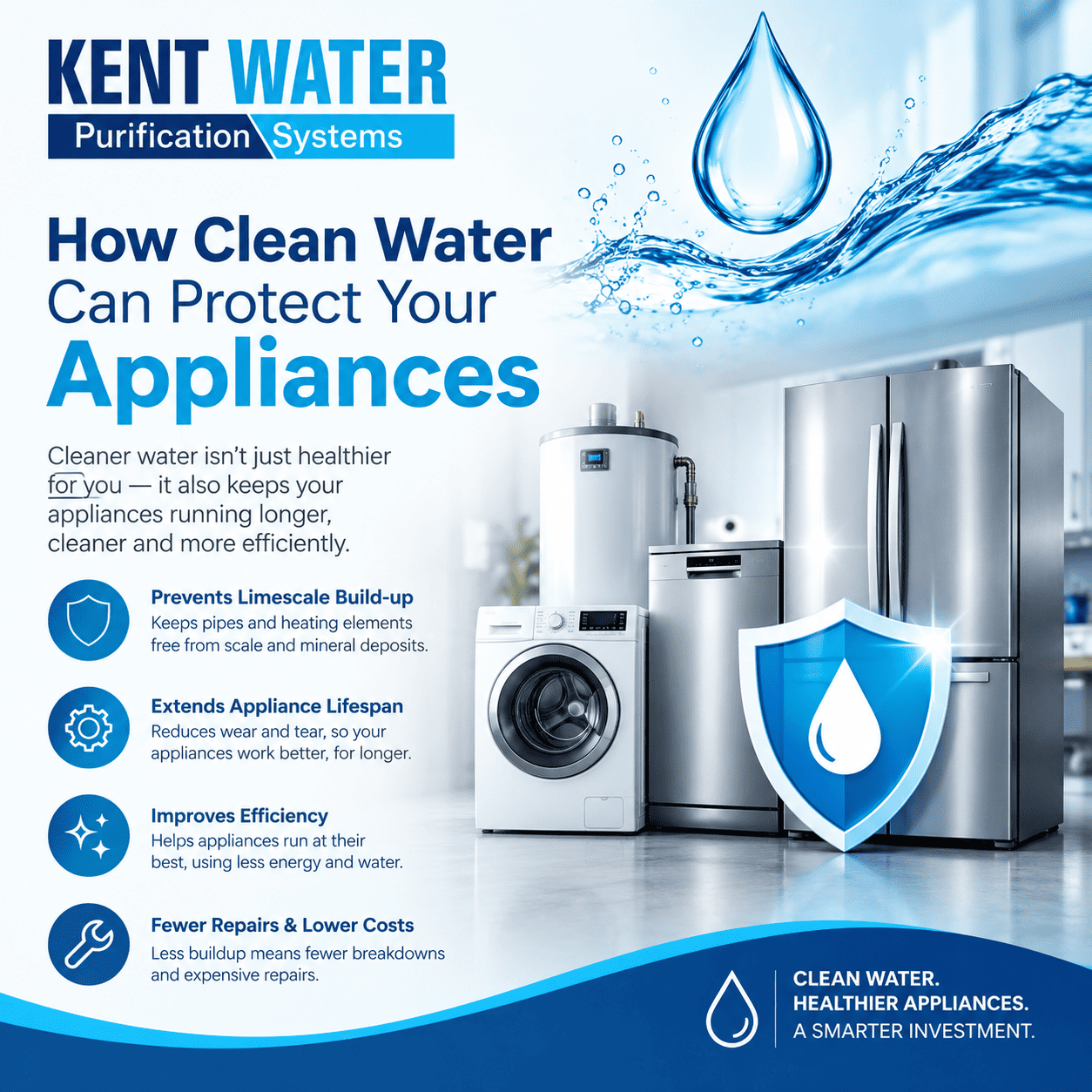
Hard water carries dissolved calcium and magnesium. On their own, these minerals aren’t a health concern, but they behave differently once water heats up. Heat causes the minerals to come out of solution and bond to surfaces, forming limescale on anything that regularly holds or heats water.
Inside a water heater, that scale layer sits directly on the heating element or tank wall. It acts as insulation, so the appliance has to run longer and use more energy to reach the same temperature. The Water Quality Research Foundation’s testing found that even a couple of millimetres of scale on a heat exchanger surface can cut heating efficiency by a meaningful percentage, and that loss compounds as scale continues to build year over year.
Where Scale Causes the Most Damage
Water Heaters
This is usually where the cost shows up first. The U.S. Department of Energy has noted that water heating makes up a significant share of typical home energy use, often cited around a sixth to a fifth of the total. Any efficiency loss from scale gets multiplied across that entire load, month after month. Left untreated, scale buildup also shortens the appliance’s working life and increases the odds of an early heating element failure.
Dishwashers and Washing Machines
Scale deposits inside valves, spray arms, and heating elements reduce how well these appliances actually clean. Many manufacturers report shorter service lives for machines run consistently on hard water, along with more frequent repair calls tied to mineral buildup on internal components.
Coffee Makers and Kettles
These heat water daily, so they show scale fastest. A scaled-up element needs more energy and more time to reach temperature, and enough buildup can affect taste, especially in coffee makers where consistent water temperature matters for extraction.
Plumbing and Fixtures
Pipes, faucet aerators, and showerheads all narrow gradually as scale accumulates on interior surfaces. Reduced water pressure at fixtures is often one of the first, easy-to-miss signs that scale has been building for a while.
Clean Water vs. Hard Water: What Changes
| Factor | Hard Water | Softened / Filtered Water |
|---|---|---|
| Heating element scale | Builds up steadily | Minimal to none |
| Water heater efficiency | Declines over time | Stays closer to factory rating |
| Appliance lifespan | Often shortened | Extended toward manufacturer expectations |
| Energy use | Rises as scale thickens | Stays consistent |
| Soap and detergent use | Often higher to compensate | Typically lower |
| Repair frequency | More frequent, mineral-related | Reduced |
How Filtration and Softening Solve This
A water softener addresses hardness directly, using an ion exchange process to swap calcium and magnesium for sodium or potassium ions before water reaches your appliances. This is the most direct fix for scale-related appliance wear, and it’s why a water softener system in Mississauga is one of the most common recommendations for homes on municipal or well water with elevated hardness readings.
A whole house water filtration system in Mississauga can be installed alongside or instead of a softener to handle a broader set of issues, including sediment and chlorine, which can also affect appliance seals and gaskets over time. The two systems solve different problems, and many households run both: a softener for hardness, and a whole house filter for sediment, chlorine, and general water quality.
Homeowners across the wider GTA deal with this too. The reasons Toronto residents look into hard water treatment are similar to those in Mississauga and Peel Region, since much of southern Ontario draws from sources with moderate to high mineral content.
Expert tip: If you’re not sure whether hardness or sediment is your main issue, ask for a water hardness test in grains per gallon before choosing between a softener and a broader filtration system. The number tells you which problem you’re actually solving.
Signs Your Appliances Are Already Affected
- Water heater making popping or rumbling noises. This is often trapped water boiling underneath a layer of scale.
- Dishes or glasses coming out cloudy or spotted. Mineral residue left behind after washing is a common hard water symptom.
- Noticeably lower water pressure at fixtures. Gradual narrowing from scale buildup is a frequent, overlooked cause.
- Rising energy bills without a clear explanation. Appliances working harder to overcome scale use more power for the same output.
- Appliances failing earlier than their expected lifespan. If a water heater or dishwasher needs replacing well ahead of schedule, water quality is worth investigating.
Key Takeaways
- Scale from hard water insulates heating elements, forcing appliances to use more energy for the same result
- Water heaters typically show the earliest and most costly efficiency losses
- Softened or filtered water helps appliances hold closer to their factory-rated performance and lifespan
- A water softener addresses hardness directly; a whole house filter covers sediment and chlorine as well
- Testing your water’s hardness level is the fastest way to know which system actually fits your home
Frequently Asked Questions
How quickly does scale build up in a water heater?
This depends on your water’s hardness level and usage, but noticeable efficiency loss can begin within a few years in moderately hard water, and faster in very hard water areas without treatment.
Does a water softener really extend appliance life?
Research on water heaters specifically has shown units running on softened water maintaining efficiency much longer than those on untreated hard water, which supports longer effective appliance life.
Is hard water bad for my health?
No. Health authorities don’t classify hard water as a health risk. The concerns around it are economic and mechanical, tied to appliance wear and higher utility costs, not health effects.
What’s the difference between a water softener and a whole house filter?
A softener removes hardness minerals through ion exchange. A whole house filter typically targets sediment, chlorine, and taste or odour issues. They solve different problems and are often installed together.
Can I test my own water hardness?
Yes, home test strips give a rough reading, though a professional water test gives a more precise grains-per-gallon number to size a softener correctly.
Do tankless water heaters have the same scale problems?
Yes, and in some cases scale affects tankless units more noticeably, since their heat exchangers have less surface area to compensate for buildup.
Will a softener affect my drinking water taste?
Softened water typically has a slightly different mineral profile, and some households prefer to keep a separate drinking water tap, such as a reverse osmosis system, for cooking and drinking.
How do I know if I need a softener, a whole house filter, or both?
A water test showing high hardness points toward a softener. If chlorine taste, sediment, or general water quality is also a concern, pairing a softener with a whole house filter usually covers both issues.
Conclusion
Appliance wear from hard water happens slowly enough that most homeowners don’t connect the dots until a water heater fails early or an energy bill jumps for no obvious reason. Treating the water before it reaches your appliances is a more predictable, lower-cost approach than repairing or replacing equipment that scale has already damaged.
If you want a clear picture of what’s actually in your water before choosing a system, Kent Water can test your home’s hardness and water quality and recommend whether a softener, a whole house filter, or both make sense for protecting your appliances long term.